

Memory care
How to Talk With a Parent Who Has Dementia (Without It Feeling Like a Quiz)
By Joy Senior Living
My mother-in-law used to ask me the same question maybe six times in an afternoon. "Did you eat yet?" And the first few times I answered like it mattered, like she was keeping track. She wasn't. She just wanted to talk to me, and that was the question her mind handed her.
Once I understood that, our afternoons got a lot easier.
If you're visiting a parent with dementia, you've probably felt the thing I felt. The conversation turns into a quiz. "Do you remember what we did yesterday?" "Do you know who this is?" "Guess what today is." We don't mean it as a test. We're trying to pull them back to us. But it lands like a pop quiz they can't study for, and you can watch it wear on them.
So let's put the quiz down.
Ask about right now, not about yesterday
Memory for recent events fades early. Asking someone to recall what they had for lunch can feel like asking them to read a page that's been erased. It's frustrating for them and heartbreaking for you.
But right now is available. The sun coming through the window. The song on the radio. The dog that just walked by. Talk about what's in front of both of you.
Instead of "Do you remember our trip to Savannah?" try "That's a pretty color you're wearing." Instead of testing the past, comment on the present. You'd be surprised how much a person can say about a warm cup of coffee in their hands.
Follow the feeling, not the facts
Here's something the caregivers at Joy talk about a lot. When a parent says something that isn't true ("I need to go pick up the kids from school"), the instinct is to correct it. Don't rush to. Ask yourself what feeling is underneath.
Maybe the kids are grown and gone. But the feeling, that pull to take care of someone, that's real and worth honoring. You can meet it with "You always took such good care of everybody. Tell me about when they were little." Now you've turned a dead end into a doorway.
Mellissa Daniel, who runs things here, puts it simply. You're not trying to win the argument about what's factual. You're trying to keep your mom company. Those are two different jobs.
Let them lead you
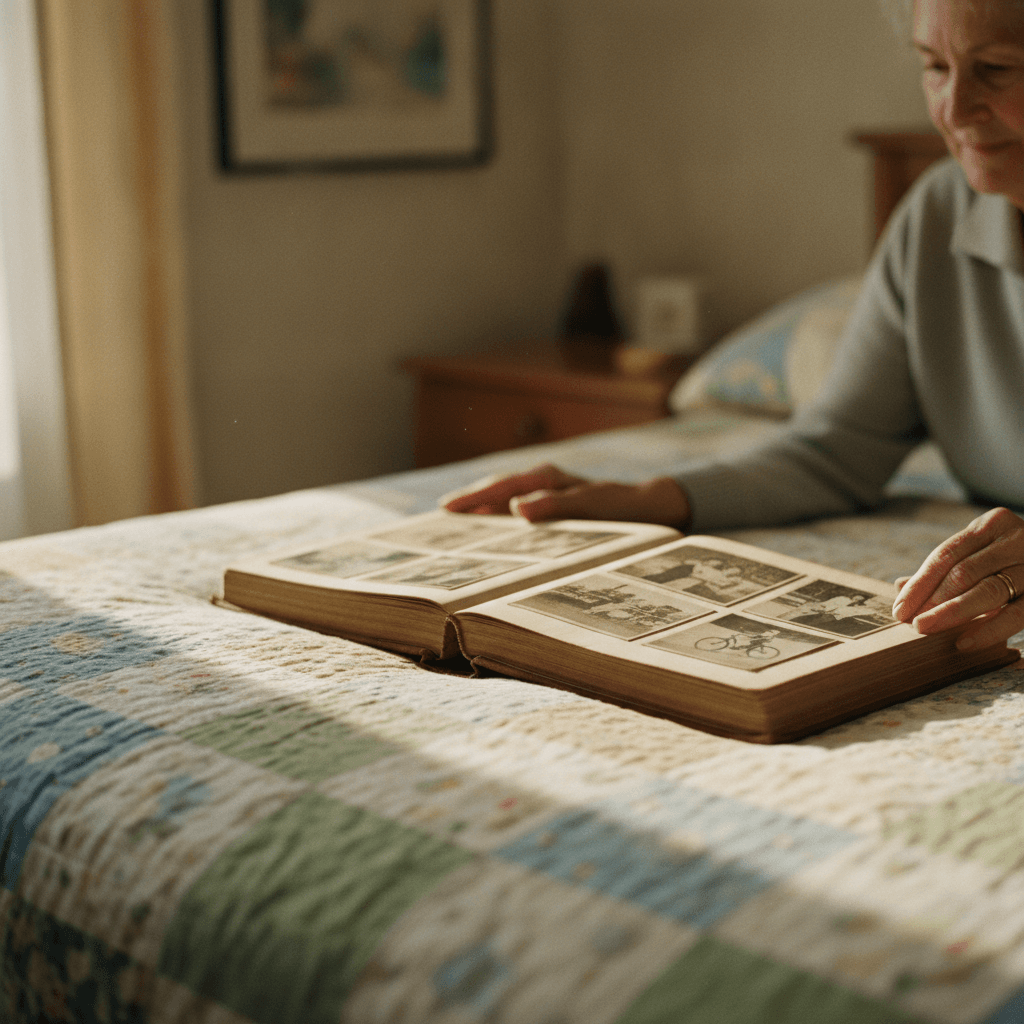
Some of the best visits happen when you stop steering. Bring an old photo album, but don't grill her on names. Just open it and see what she reaches for. Play music from when she was young (a lot of long-term memory lives in songs) and let her hum. Fold towels together. Shell peas. Look out the window at the birds.
A task the hands remember gives the mind a rest and gives you both something to do besides stare at each other trying to make talk happen.
And when there's a silence, let it sit. You don't have to fill every quiet second. Sitting next to someone is its own kind of conversation.
Small questions beat big ones
Open-ended questions can overwhelm. "What do you want to do today?" is a lot to sort through. "Would you like to sit outside?" is easier. You're not talking down to her. You're clearing a path so she can answer without getting lost.
Give her time, too. Longer than feels natural. Count to ten in your head before you jump in. Sometimes the words are there, they're just walking a longer road to get to her mouth.
When it goes sideways
It will, some days. She'll get agitated, or she won't know you, or she'll repeat the same worry until you want to scream into a pillow in the parking lot. That's not you failing. That's the disease.
On those days, you can step back. Change the subject to something soothing. Offer a snack. Go get a glass of water and come back in three minutes as if you just arrived. A fresh start often resets the whole mood.
Here at Joy, we're a small personal care home in Loganville, just 24 beds, and one thing that scale gives us is time to actually sit with people. Our staff learns which song calms which resident, who likes to talk at breakfast and who'd rather have their coffee in peace. If you're looking at memory care and worried your parent will become a room number, ask about that. Ask how many people one caregiver looks after. The answer tells you almost everything.
Your mom may not remember that you came. But she'll remember, in the way that counts, that she felt safe and easy for an hour. That feeling outlasts the facts. Chase that, and you'll both leave the visit lighter than you came.
Learn more about memory care at Joy, a personal care home in Loganville, GA.
Related reading
Come see the home
The best way to know if Joy is right for your parent is to walk through it. Book a tour, or call us at (470) 684-3569.